
For years, “minimalism” was synonymous with “stark.” We pictured cold white walls, sharp-edged furniture, and spaces so sterile they felt more like art galleries than homes. But as we move through 2026, a new movement has taken over: Warm Minimalism.
Warm minimalism is the art of “less is more,” but with a soul. It’s about stripping away the clutter while leaning heavily into sensory experiences—soft fabrics, raw woods, and organic shapes. The goal isn’t to live in an empty box; it’s to create a sanctuary that feels breathable yet deeply cozy.
Here are 10 ways to master warm minimalism in your living room using the power of natural textures.
1. The “Texture-First” Neutral Palette
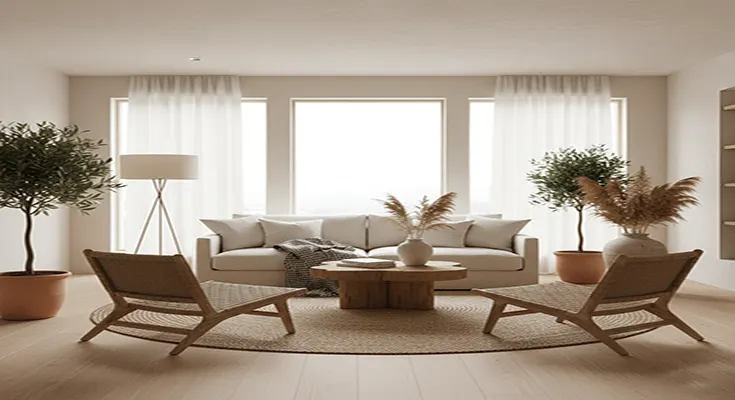
In a warm minimalist room, you don’t need bright colors to create interest. Instead, you use a monochromatic texture palette. * The Idea: Stick to shades of bone, sand, oatmeal, and taupe. Because the colors are similar, the eye begins to notice the textures—the weave of a linen sofa, the grain of an oak table, and the softness of a wool rug.
- Why it works: It creates a visual “quiet” that lowers cortisol levels while the warm undertones prevent the space from feeling clinical.
2. Incorporate “Live-Edge” Wood Elements
Traditional minimalism often uses polished, man-made materials. Warm minimalism embraces the “perfectly imperfect.”
- The Idea: Replace a glass or plastic coffee table with a solid, live-edge wood piece. Keep the natural knots, cracks, and uneven edges visible.
- Why it works: Wood brings an immediate sense of “grounding” and earthiness to a room. It connects the indoors to the natural world outside.
3. Layered Textiles: The 3-Fabric Rule
To avoid the “cold” look, you must layer fabrics. A single leather sofa in an empty room looks lonely; the same sofa with a chunky knit throw looks intentional.
- The Idea: Follow the 3-Fabric Rule: pair a heavy weave (like boucle), a breathable fiber (like linen), and a natural animal-free pile (like high-quality faux mohair or thick wool).
- Why it works: Variety in textile height creates “visual weight” that fills the room without adding actual clutter.
4. Swap Sharp Angles for Organic Curves
Modernism is obsessed with the 90-degree angle. Warm minimalism is obsessed with the curve.
- The Idea: Look for “kidney-shaped” sofas, arched doorways, or circular coffee tables. Even a round jute rug can break up the harsh lines of a rectangular room.
- Why it works: Soft edges mimic the shapes found in nature. Psychologically, humans feel safer and more relaxed around rounded objects than sharp, pointed ones.
5. The Power of Plaster and Lime-Wash Walls
Flat, satin-finish white paint can feel “thin” and cold. In 2026, texture has moved from the furniture to the walls.
- The Idea: Use a lime-wash or Venetian plaster finish on your main walls. These finishes create a subtle, cloudy movement that catches the light beautifully.
- Why it works: It adds “tactile depth.” Even when you aren’t touching the wall, your eyes can feel the grit and the history of the application.
6. Jute and Sisal: The Foundation of Grounding
Nothing defines warm minimalism like a natural fiber rug.
- The Idea: Use a large, chunky-knit jute rug as your base. If you want more comfort, you can layer a smaller, softer wool rug directly on top of it.
- Why it works: Jute is durable, sustainable, and adds an “organic tan” color to the floor that anchors the lighter furniture above it.
7. Integrated Greenery as Architecture
In minimalism, plants aren’t just “decor”—they are living sculptures.
- The Idea: Instead of ten small succulents, choose one large, structural plant like a Fiddle Leaf Fig or an Olive Tree in a large terracotta or stone pot.
- Why it works: One large plant creates a focal point and introduces a natural, vibrant green that pops against a neutral background without feeling messy.
8. Focus on “Low-Slung” Furniture
Height can sometimes create a sense of formality and distance. Lowering the center of gravity makes a room feel more intimate.
- The Idea: Choose a “low-profile” sofa and lounge chairs. When your seating is closer to the ground, the ceilings feel higher and the atmosphere feels more “lounge-like” and relaxed.
- Why it works: It’s a nod to Japanese and Mediterranean design styles that prioritize comfort and ease of movement.
9. Ambient Lighting: The “No-Overhead” Policy
The quickest way to kill a minimalist vibe is with a harsh, clinical overhead light.
- The Idea: Use “warm-dim” LED technology. Distribute light through floor lamps with linen shades, ceramic table lamps, and hidden LED strips behind furniture to wash the walls in light.
- Why it works: Soft, diffused light hitting natural textures (like a plaster wall or a wood grain) creates shadows and highlights that make the room feel three-dimensional at night.
10. Curated “Empty” Space
The most important “texture” in minimalism is air. * The Idea: Be brave enough to leave a corner empty. Don’t feel the need to fill every wall with art or every surface with a tray.
- Why it works: Empty space allows the high-quality textures you did choose to breathe and be appreciated. It gives the human mind a place to rest.
The “Warm Minimalism” Checklist
Before you start your redesign, ask yourself these three questions for every piece you bring in:
- Does it have a tactile quality? (Can I feel the grain, the weave, or the stone?)
- Does it serve a purpose? (Is it for comfort, light, or storage?)
- Is the color “grounded”? (Does it look like it could be found in a forest, a desert, or a mountain?)
A Home That Hugs You
Warm minimalism isn’t about the absence of things; it’s about the presence of peace. By focusing on natural textures, you transform a living room from a “display” into a home. It’s a space that doesn’t demand your attention with bright colors or loud patterns, but rather invites you in with a quiet, textured hug.